Binding Affinity Module
The biggest misconceptions in introductory biology cluster around emergent behavior — how molecular interactions at one scale produce the bulk phenomena we observe at another. The Binding Affinity module is an attempt to teach that bridge directly, by letting students run the simulation themselves.
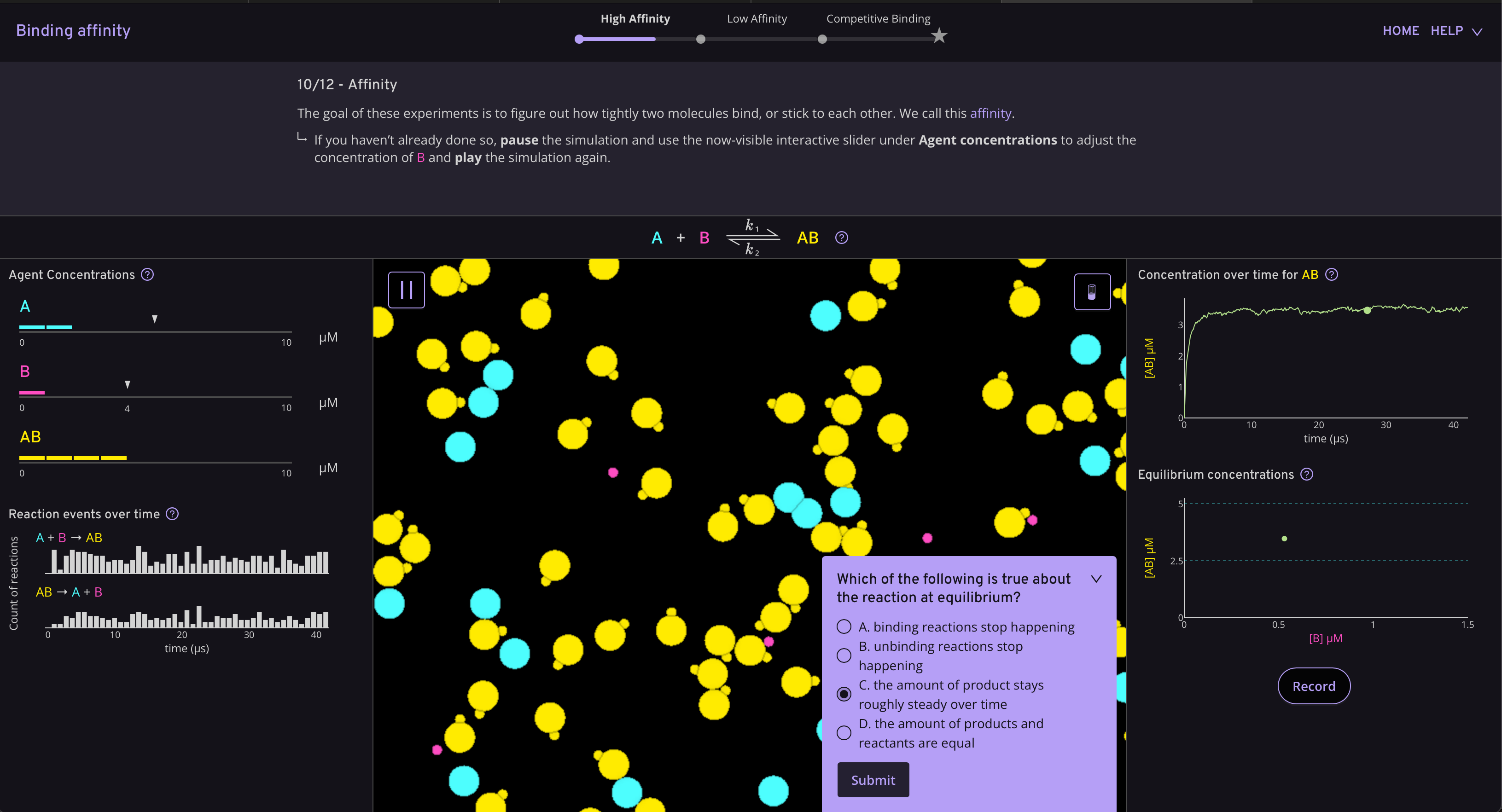
Most biology curricula introduce binding affinity through clear-liquid lab work and equilibrium constants on a board. The leap from that to a molecular picture of A + B ⇌ AB happening millions of times per second is one many students never make. Simularium gave us a substrate to close that gap: a browser-based agent simulation that students can pause, adjust, watch reach equilibrium, and record measurements from.
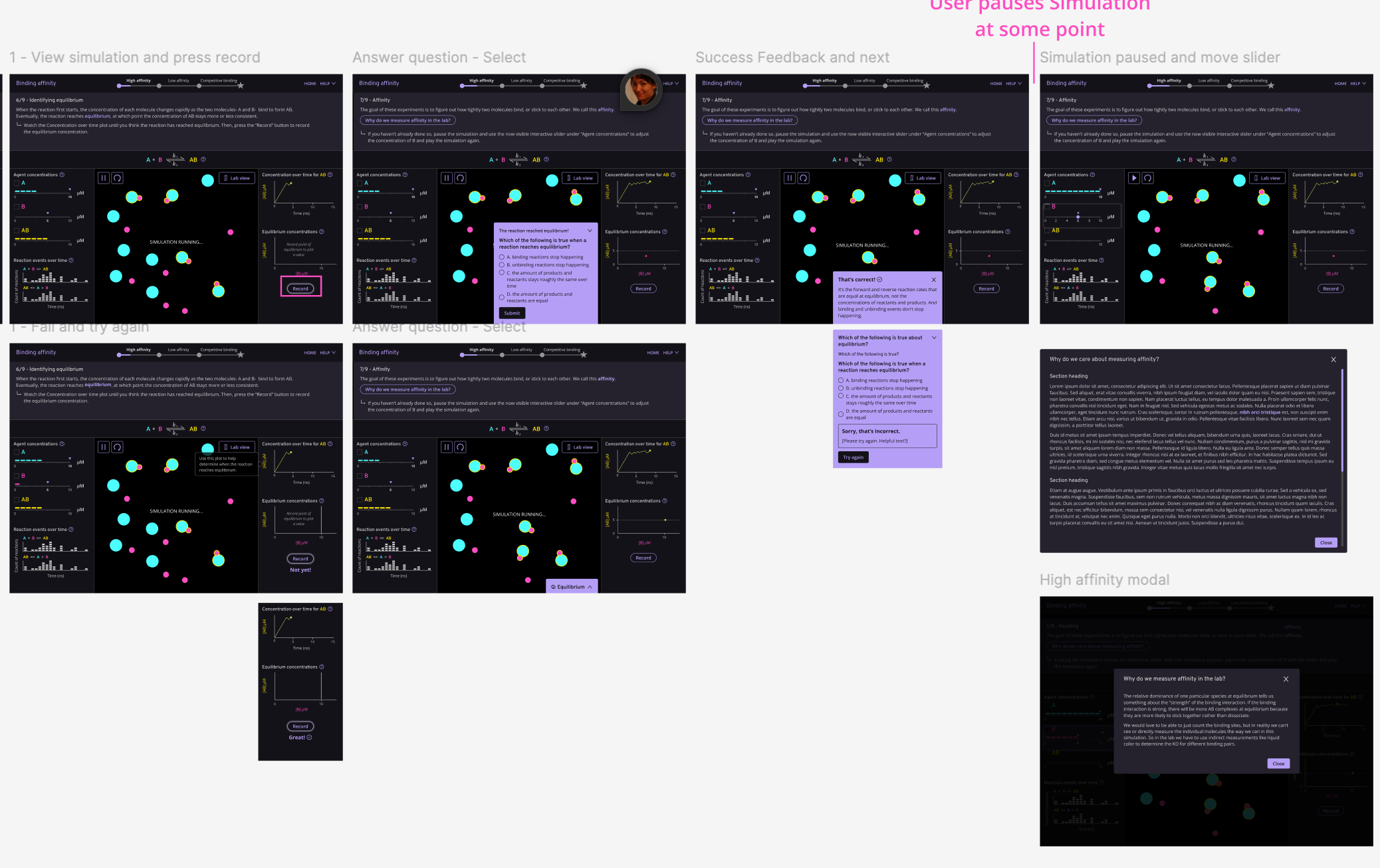
Major misconceptions in biology tend to cluster around how emergent behaviors come out of molecular interactions.
I led the module design with Lyndsay Wilhelm (senior UX). Three principles drove the work: balance self-directed and guided experience so students can wander but don't get lost; keep agents visually simple so the lesson is about simulation versus measurement, not 3D rendering; and keep the surrounding text minimal so instructors can slot the module into existing lessons without rewriting their syllabus. Students progress through high-affinity, low-affinity, and competitive-binding scenarios — recording equilibrium concentrations and deriving Kd from the data themselves.
The module is the first of a planned series. We're applying for grant funding to evaluate learning outcomes and are designing follow-up modules on membranes and on actin polymerization — both areas where the gap between molecular intuition and observable behavior is especially wide.